
So far in life I’ve been lucky enough to not have any major ailments or hospitalizations. I do, however, seem to suffer from a bunch of other pesky health conditions that rear their ugly heads from time to time, just to make me appreciate my health even more. We’ve already covered my panic attack/anxiety issues, but at age 30 I also was diagnosed with endometriosis. That took a good nine years to officially get diagnosed (thanks, doctors and nurses who thought the pain was all in my head – I told you something was wrong.) That’s a whole other long and frustrating story. But first, let’s talk about allergies.
Let me start out by saying that I grew up in a family of seasonal allergy sufferers. It was just normal to have several boxes of tissues in every room in the house; we were perpetually blowing our noses. My brothers seemed to have gotten the worst of it. To make matters worse, the practice field for high school football was basically right next to a field of ragweed – as if their practices weren’t grueling enough without all of the itchy eyes, and constant sneezing and wheezing. Up until recently, I hadn’t realized it was rude to blow your nose in some public areas; I’d become so immune to it that it was as if someone was talking. And let’s face it: If my family members had left the room every time they had to blow their nose, we’d never see each other.
For whatever reason, I’d seemed to luck out in the allergy area, until I hit my early 20s. When I was about 22 years old and suffering through my very first “real” job in customer service at a paper plant (I know, a totally sexy job, right?), my allergies suddenly, viciously flared up. Since it wasn’t even ragweed season and I was tired of looking like a drunk, I finally decided to go to an allergist to get tested. The nurse pricked my back with something that felt like a hairbrush, carefully applying all of the different doses of things that could possibly cause a reaction. She left the room then, while I sat and waited for the offenders to kick in. Sure enough, within a minute or so one particular part of my back became unbearably itchy. I also noticed a few other areas that were somewhat itchy, although not as bad as the ultimate mosquito bite covered in poison ivy with a chronic hives chaser that was forming in the middle of my back. It turned out that the main culprit was none other than … dust mites. The other two were ragweed and cat dander, which really came as no surprise. But dust mites? Didn’t dust surround us at all times? How the hell was I supposed to avoid dust? It sounded as horrible as those people who are allergic to the sun.
I was quickly presented with a supersized picture of an actual dust mite, magnetized so that I could see every single nasty, hairy detail of the minuscule bug that was making my life so miserable. All I could think about were those tiny disgusting creatures multiplying all around me. They were in my pillows. In my couch. In my carpeting and rugs. And especially in my mattress. My mission was clear: I needed to eradicate them immediately.
Little did I know that arming oneself with the proper allergen-reducing tools almost required a small personal loan. First I needed to purchase special casings for all of my pillows and mattresses. Next, I needed a special spray to use on my couch and carpeting. Lastly, I needed a prescription for Claritin, like stat. (That was before it was OTC.) Thankfully that all worked like a charm, and I immediately started to feel relief. At least for a little while.
Once my sneezing was under control, I started to get other kinds of allergic reactions – but on my skin. (Seriously, is there a connection between allergies and those people who suffer from anxiety? Why are the nerds always sneezing and itchy?) I got on top of those with the help of special lotions and sprays; eventually it all just mysteriously went away, and I’ve been rash-free ever since.
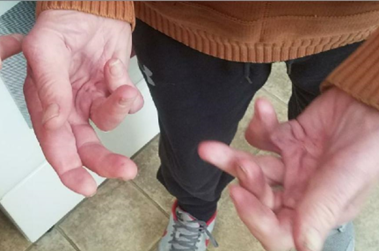
Which brings me to the one thing I haven’t been able to conquer: Dupuytren’s contracture, which my family just calls Dupuytren’s. (Pronounced doopa-trons. That even sounds Polish, doesn’t it? Well, at least the doopa part does.)
Most people have never heard of the condition, but it’s pretty evident when someone has it. According to the Mayo Clinic’s website, Dupuytren’s is “a hand deformity that usually develops over years. The condition affects a layer of tissue that lies under the skin of your palm. Knots of tissue form under the skin – eventually creating a thick cord that can pull one or more fingers into a bent position.”
For whatever reason Dupuytren’s is common in those of Northern European descent; my Polish grandmother and most of her siblings had it. My dad and his brothers also inherited it, and now my brothers and I wonder if we, too, will have mangled hands. Peter convinced himself that if he kept bending his fingers backward he could somehow ward off the disease. So far all I think he’s accomplished is grossing people out. He self-diagnosed as having “Reverse Dupuytren’s.”
In the past, my dad had a few surgeries to open up his bent fingers, but the effects wore off after awhile. The deformity fought right back and took over his hand again. It’s kind of like if you had braces on your teeth but didn’t wear a retainer afterward; the teeth would shift right back out of place.
Growing up as smart-alecky Polish kids, my brothers and I preferred to make fun of our relatives with the crazy hands (in a strictly endearing sort of way, I assure you). Take my Great-uncle Bernie, for example. When Bernie was elected an alderman in the town of Peshtigo, his picture was in the weekly “Peshtigo Times,” being sworn in: one hand on the Bible, one hand up. Only instead of holding a palm up, Uncle Bernie could only proffer a fist with a single finger; he couldn’t help it, all his other fingers were bent with Dupuytren’s. My brothers and I rolled with laughter.
From there, we developed our popular “sign of peace”/Dupuytren’s-friendly handshake during Catholic mass. (Background for the non-Catholics: At one point during the service, everyone extends a “sign of peace,” aka a handshake, to everyone sitting around them. This happens about three-quarters of the way through mass, and it’s met with varying degrees of enthusiasm. The people who hate it just quickly say “Peace” and shake your hand without eye contact. Others are super cheerful and give you the full “Peace be with you.” My family has come to embrace this part of mass because then we can all pretend we have Dupuytren’s (whether we have it or not). My brothers and I do the “Uncle Bernie” peace handshake, where we crumple our fingers under and point one finger outward. It may sound kind of mean, but it’s really a true sign of affection. If you join our family and get the Bernie shake, you know we like you. If we can’t reach you because you’re on the other end of the church pew, then you get the “Bernie wave.” As for my dad, he doesn’t need to pretend anything; he’s got the full Bernie shake and wave down naturally. At this point, his hands are so bad that it’s difficult for him to pick up a glass.
I figured that once I reached my 40s I was in the clear. No signs of Dupuytren’s had appeared yet.
I was wrong.
Oddly enough, it all started with my feet.
The past few years I’ve noticed a few hard bumps on the bottom of my left foot. I can’t say they’re particularly painful, although sometimes they’re a bit uncomfortable. What I do know is that it feels absolutely incredible whenever someone (i.e., my husband) rubs those bumps on my foot. I’ve even gone so far as to pay for specialized foot treatments, all in hopes that someone will rub my little foot bumps and somehow magically work out all of the connective tissues and make everything normal again. However, something very peculiar happens every time I get those treatments done. It seems that the second the massage therapist feels the bumps, she avoids them like the plague. I even make a point of saying, “Hey I’ve got these bumps on my left foot that are bothering me.” Obviously that’s a strong hint to say, “Rub there, please.” But instead, she’ll find the bumps and say, “Sure enough, you’re right, you have some bumps there.” Then she’ll go on massaging every other stinking part of my foot but the bumps, as if they were some sort of contagious rash. Are these people not understanding me correctly? I want to shout at them, “Rub my bumps! Rub my bumps!” But I think that would probably get me kicked out of the massage room.
I then decided to try reflexology. Those people are supposed to know all sorts of shit about your feet, right? I’ve seen the complicated charts, where a different part of your foot corresponds to a part of your body. When I mentioned it to my mom, she told me a story about how she got her feet done; at one point she felt a strong twinge and asked the reflexologist what part of the body that was.
“The ovaries,” he proclaimed.
At the time my mom was in the middle of a heavy menstrual period.
Who are those people, gypsy fortune-tellers? I didn’t care, I was sold.
Long story short, the reflexology was quite lovely. So lovely that I fell asleep a couple of times and then woke up to about 30 new work emails. But I never felt any strange twinges or other reactions that I needed to tell the reflexologist about. Plus, like the other foot rubbers in my life (except for my husband, God bless him), she avoided the bumps. But when I mentioned them, she said it wouldn’t hurt to just get them checked out.
So, I finally broke down and made an appointment with a podiatrist, which is really just admitting to the world that you’re old. Plus, I was afraid that he was going to tell me I couldn’t ever wear high heels again. Goodbye dream of purchasing my first pair of Louboutins! Maybe I was going to end up like Sarah Jessica Parker, doomed to wearing boring flats the rest of my life after wearing too many fabulous-but-uncomfortable shoes.
Within seconds of feeling my foot, the podiatrist had an answer.
“Yup, we see one or two new cases of this every month,” he said. “You’ve got fibromas. I can feel three of them very clearly. Actually, these are usually related to some sort of hand contracture, most likely hereditary. Anyone in your family have that?”
Shit.
I then proceeded to tell him that most of the Polish side of my family has or had Dupuytren’s.
“Yes, that’s it. They’re directly related. Unless these fibromas are really bothering you or hurting you, there’s really nothing you can do about them. I wouldn’t recommend having surgery; you can really complicate matters.”
At least I had answers, but I left feeling less confident that I was in the clear. After I spread the word on Facebook, I had cousins and second cousins coming out of the woodwork, all telling me about their Dupuytren’s. One of my dad’s cousins told me hers didn’t show up until she was 63. That wasn’t exactly comforting. However, I did hear that there’s new and improved technology to ward it off once it starts. So I’ve got that going for me.
But in the meantime, I can garner more sympathy by telling my husband to “rub my Dupuytren’s.” Okay, so it may not be the actual diagnosis but close enough. Plus, if I’d ask him to “rub my bumps” I’d get an entirely different response.